 CTICases
Sclerotic Bone Metastases from Breast Cancer Mimicking Pulmonary Nodules
 ▶ Watch on YouTube — age-restricted, cannot embed here
[...]. Sclerotic Bone Metastases from Breast Cancer Mimicking Pulmonary Nodules. CTICases. Published October 4, 2015. https://cticases.com/c/658uh
Imaging findings
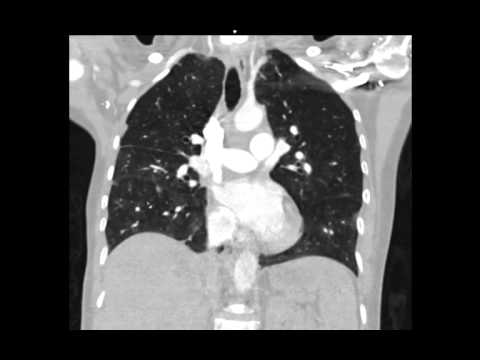
A patient with a history of breast cancer presented with what initially appeared to be widespread pulmonary metastases due to numerous discreet little nodules on chest imaging. However, careful review, including windowing and comparing areas with and without rib superimposition, clarified that these apparent nodules corresponded to sclerotic bone lesions in the ribs, scapula, clavicles, and proximal humeri, consistent with punctate sclerotic metastases from breast cancer. The lung parenchyma itself was otherwise clear.
Key takeaways
Sclerotic bone metastases, particularly from breast cancer, can project over lung fields and mimic pulmonary nodules, leading to a potential misdiagnosis of widespread pulmonary metastases. It is crucial to carefully evaluate bone structures and areas without bony overlap to differentiate true parenchymal nodules from osseous lesions. Sclerotic bone metastases are commonly seen in treated breast cancer, representing remineralization of previously lytic lesions ('flare phenomenon'), and are rare at initial presentation.
AI-assisted summary — may contain errors. Verify against the source video. Learn more
More from this webinar
- Pulmonary Tumor Thrombotic Microangiopathy in Prostate CancerNeoplastic
- Pulmonary Tumor Thrombotic Microangiopathy in Metastatic Breast CancerNeoplastic
- Spontaneous Auto-Embolization of a Pulmonary Arteriovenous Malformation (AVM)Vascular
- Iatrogenic Diaphragmatic Herniation of Mesenteric FatIatrogenic
- Metastatic Renal Cell Carcinoma Presenting as Large Pleural Effusion and Pleural MetastasesNeoplastic
- Coronary Artery Aneurysms and Occlusion in Eosinophilic Granulomatosis with Polyangiitis (EGPA) VariantAutoimmune
- Microvascular Plug (MVP) Embolization of Pulmonary Arteriovenous Malformations (AVMs)Iatrogenic
- Type A Aortic Dissection with Acute Bilateral Lower Extremity Paralysis and Retroperitoneal HematomaVascular
See all cases from October 4, 2015 →